
Aug 12, 2026News & Insights
British vs American vs Chinese Standards: What Pipeline Buyers Should Know
Compare British, American and Chinese standards for pipes, valves, fittings and flanges. Learn the key differences between BS/EN, ANSI/ASME/ASTM and GB standards before ordering.
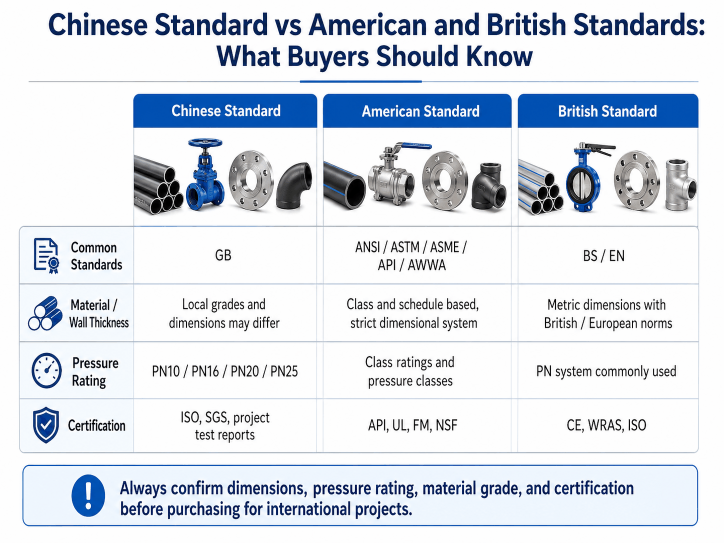
British vs American vs Chinese Standards: What Pipeline Buyers Should Know
When sourcing pipes, valves, fittings, flanges, and other pipeline products internationally, understanding the differences between British, American, and Chinese standards is essential.
Products with the same nominal size may follow different dimensions, pressure ratings, flange patterns, thread types, materials, and testing requirements. A DN100 valve or 4-inch fitting manufactured to one standard may therefore not always connect directly to a product manufactured to another standard.
For international buyers, confirming the correct standard before ordering can help prevent installation problems, incompatible connections, additional modification costs, and project delays.
British vs American Standards: What Is the Difference?
British and American pipeline standards use different systems for specifying dimensions, pressure ratings, threads, materials, and testing requirements.
British and European projects commonly reference BS, BS EN, and EN standards, while American projects may use standards published by organizations such as ANSI, ASME, ASTM, AWWA, and API.
The main differences buyers should check include:
Item | British / European | American |
|---|---|---|
Common Standards | BS / BS EN / EN | ANSI / ASME / ASTM / AWWA / API |
Size Reference | DN / mm | NPS / inch |
Pressure Reference | PN | Class |
Common Thread Types | BSP / BSPT | NPT |
Flange Standard | BS / EN series | ASME / ANSI series |
Applications | Waterworks, industrial & infrastructure | Waterworks, industrial, oil & gas |
These are general differences. The exact requirements depend on the specific product and standard number.
What Are Chinese GB Standards?
GB refers to Chinese national standards (Guobiao). China also uses related industry and recommended standards depending on the product.
Chinese standards may specify requirements for:
- Product dimensions
- Materials
- Wall thickness
- Pressure ratings
- Flange dimensions
- Mechanical properties
- Testing methods
- Coatings
- Marking and inspection
Chinese-standard products are widely used in domestic and overseas projects. However, international buyers should confirm whether GB-standard products are compatible with their existing pipeline or project specifications.
Common American Pipeline Standards
There is no single American standard covering every pipeline product.
Different organizations publish standards for different applications.
ASTM
ASTM standards are widely used for material specifications, pipes, plastics, metals, and testing requirements.
ASME / ANSI
ASME and ANSI references are commonly encountered for industrial piping components, including flanges, fittings, valves, and dimensional requirements.
AWWA
AWWA standards are widely used for municipal water supply, waterworks valves, pipes, fittings, and related equipment.
API
API standards are frequently associated with petroleum, oil and gas, industrial valves, and pipeline equipment.
For purchasing, it is better to provide the specific standard number rather than simply requesting an “American standard” product.
British and European Pipeline Standards
British and European projects commonly use BS, BS EN, and EN standards.
These standards are frequently encountered in:
- Water supply systems
- Ductile iron pipelines
- Valves and fittings
- Flanges
- Plastic piping systems
- Infrastructure projects
- Industrial piping
BS/EN specifications are also widely used in projects outside the UK and Europe, particularly in international water and infrastructure projects.
PN vs Class Pressure Ratings
One of the most common questions from international buyers concerns PN and Class pressure ratings.
British, European, and many international products commonly use:
- PN10
- PN16
- PN25
- PN40
American industrial products may use:
- Class 150
- Class 300
- Class 600
However, buyers should not assume that PN and Class ratings are directly interchangeable.
Actual pressure capability depends on the applicable standard, material, design, temperature, and product type.
For purchasing, always confirm the required standard and pressure rating shown on the project specification or drawing.
BSP vs NPT Threads
Thread compatibility is another important difference between British and American standards.
BSP and BSPT threads are widely used in British and many international piping systems.
NPT threads are commonly used in North American piping systems.
Although BSP and NPT fittings can look similar, their thread geometry and sealing characteristics differ.
Therefore, never order threaded valves or fittings based only on nominal size. Always specify the required thread standard.
Flange Standards and Compatibility
Flanges require particular attention when purchasing products from different countries.
Two flanges may both be described as DN100 or 4 inch but still have different:
- Outside diameters
- Bolt circle diameters
- Number of bolt holes
- Bolt hole diameters
- Flange thicknesses
- Raised-face dimensions
- Pressure ratings
This can cause problems when installing new valves, expansion joints, meters, or fittings into an existing pipeline.
For replacement products, buyers should provide the required flange standard or a dimensional drawing before production.
Material Standards
Material descriptions can also vary between standards.
Pipeline projects may specify particular grades of:
- Ductile iron
- Cast iron
- Carbon steel
- Stainless steel
- PVC / UPVC
- HDPE / PE
- EPDM
- NBR
A material with a similar general name does not automatically mean that its chemical composition, mechanical properties, or testing requirements are identical under different standards.
For engineering projects, always confirm the specified material grade.
Key Differences International Buyers Should Check
Before placing an order, check the following information carefully:
Check | Why It Matters |
Standard Number | Identifies the actual technical requirements |
Nominal Size | DN and NPS systems may differ |
Outside Diameter | Important for pipe and fitting compatibility |
Wall Thickness | Affects dimensions and pressure capability |
Pressure Rating | PN and Class use different systems |
Flange Dimensions | Bolt patterns must match |
Thread Type | BSP/BSPT and NPT are different |
Material Grade | Requirements vary between standards |
Testing | Test methods may differ |
Coating | Water and industrial projects may specify coatings |
Certification | Requirements depend on market and project |
Can Chinese Manufacturers Produce British or American Standard Products?
Many Chinese manufacturers supply products for international projects and can manufacture pipeline components according to different standards, depending on their production capabilities.
For example, products may be manufactured according to specified:
- GB standards
- BS / EN standards
- ANSI / ASME requirements
- ASTM material specifications
- AWWA requirements
- API requirements
However, buyers should not assume compliance simply because two products look similar.
The applicable standard, dimensions, material, pressure rating, testing requirements, and certification should be confirmed before production.
What Should Buyers Provide Before Ordering?
For international pipeline orders, provide as much technical information as possible.
We recommend providing:
- Product name
- Standard and standard number
- Nominal diameter
- Pressure rating
- Material
- Connection type
- Fluid or application
- Operating temperature
- Required coating
- Required certification
- Quantity
- Destination country
- Technical drawings when available
For replacement parts, photographs and dimensional measurements of the existing product can also help confirm compatibility.
FAQ
What is the main difference between British and American pipeline standards?
British and European systems commonly use BS/EN standards, DN sizes, PN pressure ratings, and BSP-type threads. American systems commonly reference ANSI/ASME/ASTM/AWWA/API standards, NPS sizes, Class ratings, and NPT threads. Exact differences depend on the specific product standard.
Is PN16 the same as Class 150?
They belong to different rating systems and should not automatically be treated as equivalent. The applicable standard, material, product type, and operating temperature should be checked.
Can a British standard flange connect to an American standard flange?
Not necessarily. Bolt patterns, dimensions, thicknesses, and other specifications may differ. Check the exact flange standards and dimensions before ordering.
Are BSP and NPT threads interchangeable?
They should generally not be treated as interchangeable. Their thread forms and sealing characteristics are different.
Can Chinese suppliers manufacture products to British or American standards?
Many manufacturers can produce products according to international standards, depending on the product and manufacturing capability. Buyers should provide the exact standard and technical requirements before production.
Need Help Confirming the Correct Pipeline Standard?
Choosing between British, American, European, and Chinese standards depends on the destination market, existing pipeline system, project specifications, and application.
Send us your product type, standard, size, pressure rating, material, connection requirements, drawings, and destination country, and we can help confirm the required specifications before quotation and production